



The Wood Academy has been established, a project promoted by Confindustria Bergamo together with companies in the sector and local training institutions, strengthening a collaboration built over the years and transforming it into a structured model, based on shared objectives and a medium- to long-term vision.
Imex’s participation in the Wood Academy represents a concrete commitment to contributing to the development of skills in the wood sector, by providing production know-how and industrial expertise. A contribution that reflects the company’s vision, focused on growth, process quality and the enhancement of new generations.
With a five-year duration, the Protocol focuses on creating a functional link between the world of education and the production system, with the aim of promoting a more aware and qualified access to the world of work.
The Academy fits within the framework of the guidelines of Regione Lombardia and builds on the network developed in recent years, introducing a co-designed training model involving schools, companies and institutions. An approach aimed at responding effectively and precisely to companies’ needs, avoiding overlaps and enhancing personalized pathways oriented toward employability.
The objective is twofold: on the one hand, to reduce the gap between the skills required by the market (skill mismatch) and those developed through school pathways; on the other, to experiment with innovative training solutions that strengthen the value of technical and vocational education, with concrete attention to individual potential and the diverse needs of students.
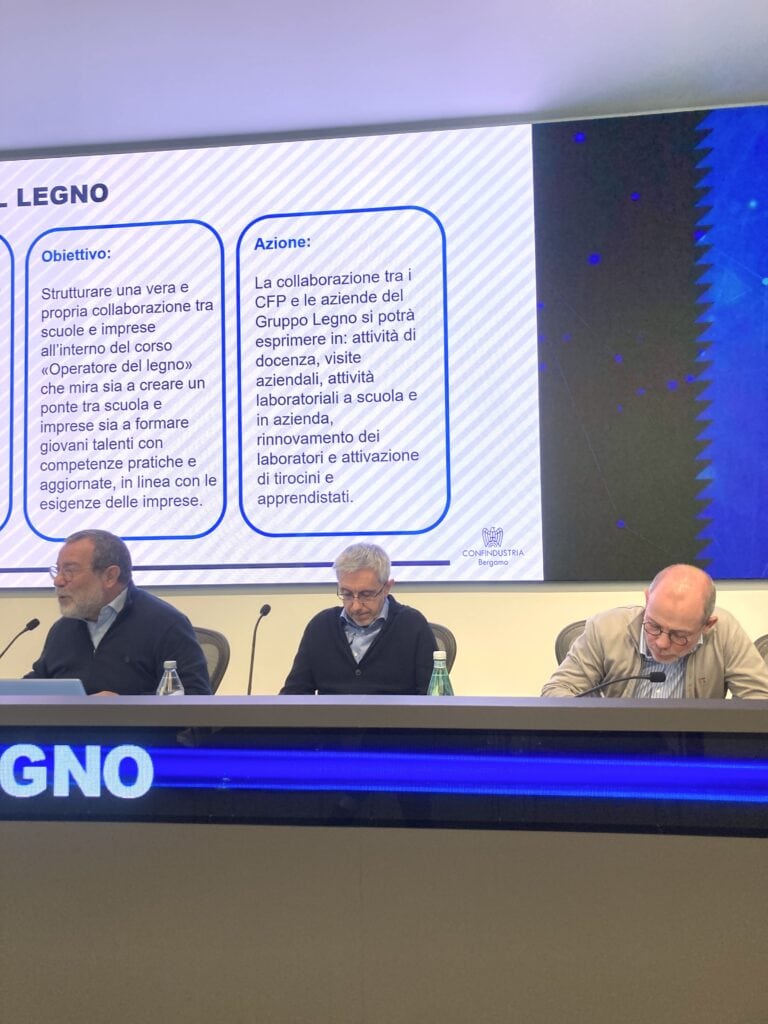
A central element of the project is the direct involvement of companies in training activities: classroom sessions led by entrepreneurs and technicians, company visits, co-designed workshops between schools and businesses, as well as internships, apprenticeships and project work. A concrete integration between theory and practice, capable of effectively bringing young people closer to the world of work.
Technical working groups are also planned, dedicated to the co-design of training pathways and the monitoring of results, with the aim of assessing the impact of the activities in terms of employability and the value generated for the local area.
The project was officially presented at the headquarters of Confindustria Bergamo, confirming the strategic value of the initiative for the future of the sector and for strengthening the link between education and industry.
Wood Academy: the voices of the key players
Piero Paganoni, President of the Wood Group of Confindustria Bergamo, emphasized the central role of training, highlighting the need to strengthen the connection between the education system and companies. He pointed out the importance of a concrete exchange between these two worlds and the direct involvement of the 15 companies in the Wood Group, also recalling the value of raw materials as a fundamental element of the supply chain.
Laura Gamba, Vice President of the Wood Group, retraced the origins of the project, which began around two years ago, and outlined the areas involved — Sebino and Val Cavallina, Bergamo city, Valle Imagna and Valle Brembana. She highlighted how, following the signing of the agreement in April, the first activities have already been launched, including visits by teachers to participating companies, and anticipated a broad program of initiatives for the next academic year, including workshops, internships, traineeships and direct collaborations with schools.
Maurizio Betelli, Director of Azienda Bergamasca Formazione, emphasized the importance of shared commitment as the starting point of the project, highlighting how mutual understanding between schools and companies is essential to building effective pathways. He also stressed the need to complement technical skills with the development of soft skills, which are increasingly relevant in the workplace.
Mario Bossi, from Scuola d’Arte Andrea Fantoni, expressed confidence in the initiative, highlighting how it is built on an already established collaboration among the training institutions involved. He pointed out the positive trend in ITS enrollments in the province of Bergamo, with a significant share linked to the wood sector, as well as the central role of the three training centers, which represent a substantial part of the local educational offering.
Don Marco Perrucchini, from AFP Patronato San Vincenzo, highlighted the value of the Academy as a structured model of collaboration between schools and businesses, capable of making training pathways more aligned with real market needs. He also emphasized how this approach, supported over time by Regione Lombardia, represents an important opportunity for the local area and helps offer families a more concrete and up-to-date perspective on vocational education.